
Progress Report
Learn more here about what the Progress Report has been designed to do, the 4 domains, the history of its creation, and our contributors.
What is the Progress Report and why should my organization participate?
The Racial Health Equity Progress Report is a 32-question self assessment tool created to assess organization performance in addressing racial disparities in their provision of health care.

Designed to be completed collaboratively within an organization, it promotes engagement with others on this topic, facilitating conversation on racial health equity.

After submission, your organization will be sent the data analytics to identify the greatest areas of opportunity.

Prepared with your organization’s personal data, it’s time to put it to use. You are supplied with tools and resources to utilize that data, identify areas of improvement, and move to action.
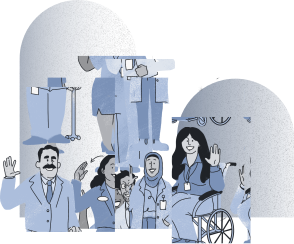
As our collaborators created the Progress Report, these were our guiding principles:
Center on Racial Equity
This racial equity assessment focuses on the people of color most impacted by systemic racial inequities in healthcare: Black/African American, Hispanic/Latino/a/x, and Indigenous people.
Facilitate Collaboration
Each provider is at a different point on this journey. Using Progress Report data, the provider community will share best practices, celebrate growth, and set collective goals.
Promote Organizational Growth
The data you share will not be made public. We want organizations to assess where they are and determine how to grow. This tool is meant to de-silo communication and activities within an organization in the equity space. It serves as a platform for discussion to bring more folks around the table in a collaborative effort.
Mobilize Towards Action
It is important to start now and rapidly understand the baseline across a core set of metrics to get a sense of different providers’ starting points. This assessment is designed to create condensed upon action in the equity space. This work is a place to start, and will develop over time.
Focus on High Impact Metrics
10 composite metrics are aligned within the four pillars of the Progress Report. This Progress Report uses fewer, but more impactful metrics across internal and external functions to avoid an overly broad scope and/or “analysis paralysis.”
All questions in the progress report fall under one of four domains
Our People
‘Our People’ challenges organizations to look in the mirror and evaluate their own boards, leadership teams and employees. This domain explores how diverse, equitable and inclusive representation is from the top down.
Themes: board and leadership team demographics; employee engagement in anti-racist, implicit bias and racial health disparity training; and pay equity
Studies show that higher perceptions of diversity and inclusion are positively correlated with employee engagement. Ensuring diversity within the board, leadership and staff enhances inclusion, improves provider-patient communication, and increases accessibility, ultimately mitigating health disparities. Our challenge is to move beyond “checkbox diversity” and ensure meaningful organizational changes and engagement.
Our Organization
‘Our Organization’ emphasizes the internal strategies, policies and practices that are important to advancing health equity. Spotlighted here is our data and analytic focus on health equity metrics like REAL, SOGI and SDOH data.
Themes: internal policy & strategy, trainings, REaL, SOGI, and SDoH data
Engaging with different tools and training helps organizations better understand and engage with patient populations that experience barriers to health access and care. Collecting self-reported data on race, ethnicity, language (REaL), sexual orientation, gender identity (SOGI), and social determinants of health (SDoH) is vital for identifying and reporting inequities in care. Informed by this data, providers can better serve their patient populations and implement needed services or programs. Adequate staff training and data protections are essential given the sensitivity of these topics.
Our Patients
‘Our Patients’ acknowledges those we serve and asks if we have a strong understanding of who we are serving, and what clinical inequities exist across our patient populations within our communities.
Themes: patient experience, patient safety, clinical inequities, access
Evaluating the current patient experience, patient safety and health outcomes can unveil underlying disparities and help to drive care improvement projects. This domain highlights the importance of focusing on inequitable outcomes through demographic breakdowns of our patient population, what charity care policies, language and literacy access processes, and to what extent we are assessing and analyzing patient experience by demographic groups.
Our Community
Our Community asks if we are working with community based organizations and other stakeholders in our communities, as improving health equity has to be done with the community – not to the community.
Themes: community engagement, collaboration,
Community involvement in healthcare enhances care possibilities by fostering collaboration with diverse stakeholders, health professionals, and service users. This strategic approach enables officials to understand community needs, facilitate targeted healthcare planning and implementation for specific populations. Prioritizing people in healthcare efforts builds lasting engagement and strengthens health systems.
In response to the disparate COVID-19 infection and death rates in Black and Latino/a/x communities, in April of 2020, the City of Chicago convened West Side United, community leaders, and healthcare providers to form the Racial Equity Rapid Response (RERR) Team.
Following the murder of George Floyd, 40 healthcare providers published a transformative statement declaring racism a public health crisis.
That statement was the genesis of a movement which has led to the creation of the Racial Equity in Healthcare Progress Report (Progress Report). The Progress Report is an assessment committed to working together as an ecosystem to overcome systemic racism and the health care disparities.
In 2021 the Illinois Hospital Association launched the progress report to providers across the state. More than 140 Illinois hospitals have completed self-assessments so far. Thanks to a 2022 grant from the Commonwealth Fund, RUSH University Medical Center is helping test and validate the progress report on a national scale. Co-investigators are David Ansell, MD, MPH, the Medical Center’s senior vice president for community health equity, and Brenda Battle, RN, BSN, MBA, senior vice president for community health transformation at UChicago Medicine.
The co-investigators of the Progress Report are David Ansell, MD, MPH, the Medical Center’s Senior Vice President for Community Health Equity, and Brenda Battle, RN, BSN, MBA, Senior Vice President for Community Health Transformation at UChicago Medicine.
In addition to the pilots and feedback we have solicited from partners in Illinois, we have also gathered input from over two dozen national health equity groups, community leaders, survey creation experts and leaders in health equity. We thank the organizations listed below immensely for their thought partnership.
America’s Essential Hospitals
American Hospital Association’s Institute for Diversity and Health Equity (IFDHE)
Centers for Medicare & Medicaid Services (CMS)
Civic Consulting Alliance (CCA)
Democracy Collaborative / Healthcare Anchor Network
Human Rights Campaign’s Healthcare Equality Index
Illinois Health and Hospital Association (IHA)
Illinois Coalition for Immigrant & Refugee Rights
Chicago Department of Public Health (CDPH)
We would like to give special thanks to our distinguished Technical Expert Panel (listed below). These experts from across the country have been a powerful steering committee, helping our team grow and evolve the Progress Report. We thank them for their dedication to advancing health and racial equity with the communities they serve and within this grant.

Stacey Barrett ,MA
Research Scientist, The Joint Commission

Camara Phyllis Jones, MD, MPH, PhD
Adjunct Associate Professor, Morehouse School of Medicine

Luella Toni Lewis, MD
Co – Founder, The Health Equity Cypher

Alejandra Rincon, PhD
Assistant Vice Chancellor and Chief of Staff, Office of Diversity and Outreach, University of California San Francisco

Dana Gelf Safran, PhD
President & Chief Executive Officer, National Quality Forum

Deirdre Mylod, PhD (Chair)
SVP of Data and Analytics at Press Ganey and co-chair of our Equity Partnership

Matt Austin, PhD
Associate Professor of Anesthesiology and Critical Care Medicine (Consultant on Leapfrog), Johns Hopkins University School of Medicine

Shannon Welch, MPH
Director for the Institute for Healthcare Improvement (IHI)

Scott Cook, PhD
Co-Director Advancing Health Equity / Care Transformation Strategist , UChicago Medicine and Biological Sciences

Pamela Abner, MPA, CPXP
Vice President & Chief Diversity Operations Officer, Mount Sinai Hospital Groups

Fernando G. Little, MSL
VC-Diversity and Outreach, VCDO Administration , Atrium Health

Karthik Sivashanker, MD, MPH, CPPS
Vice President of Equitable Health Systems and Innovation,American Medical Association; Medical Director of Quality Safety and Equity, Brigham Health