Pitching & Storytelling

Successful large-scale change in healthcare requires backing from CEOs and executive boards. As healthcare and equity leaders, it’s our responsibility to make sure the importance of our work is communicated to those in power. That’s why we are sharing the following two strategies for crafting the perfect pitch and telling impactful stories. 

Strategy Number 1: The Mission Model Canvas

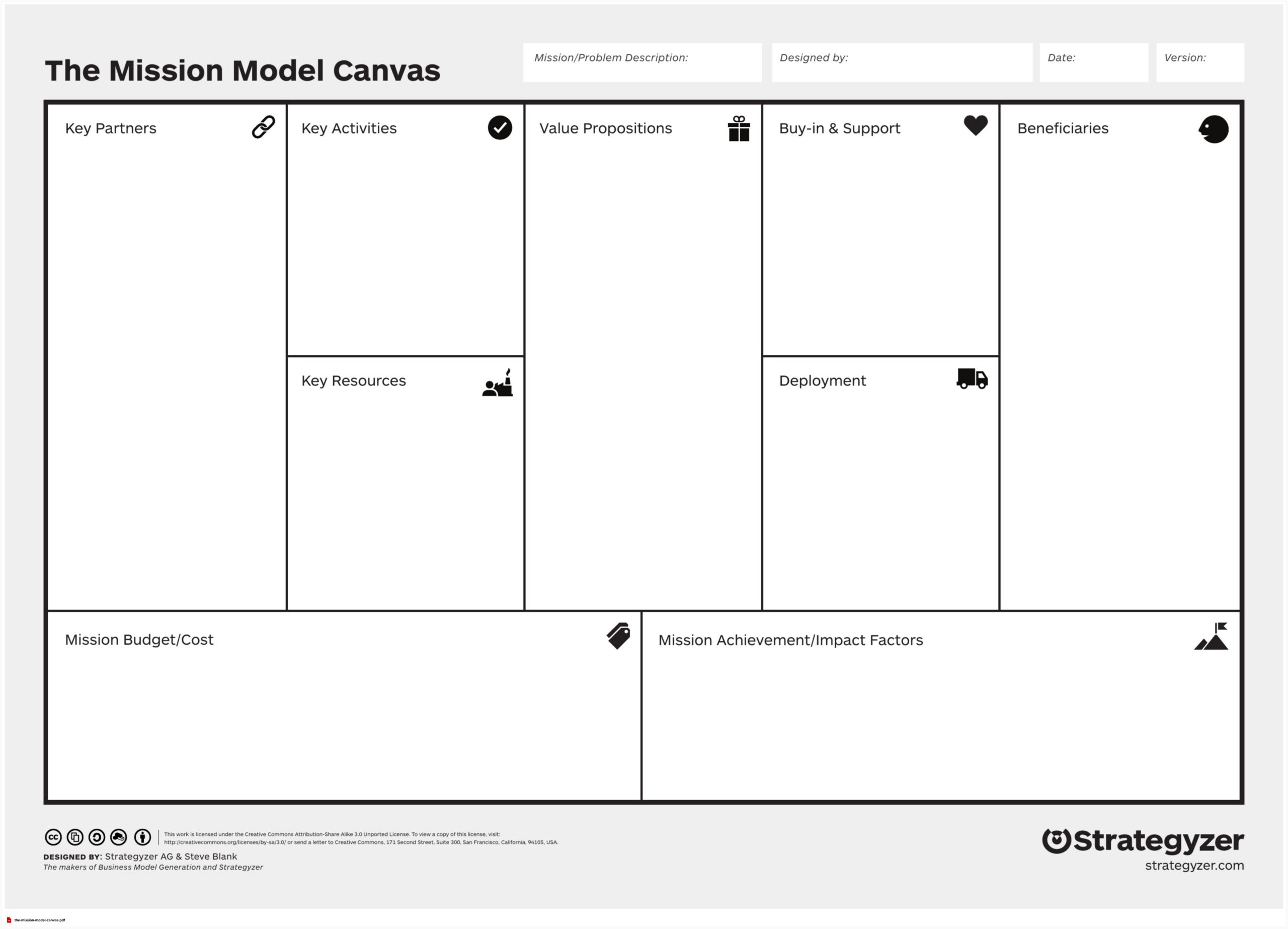
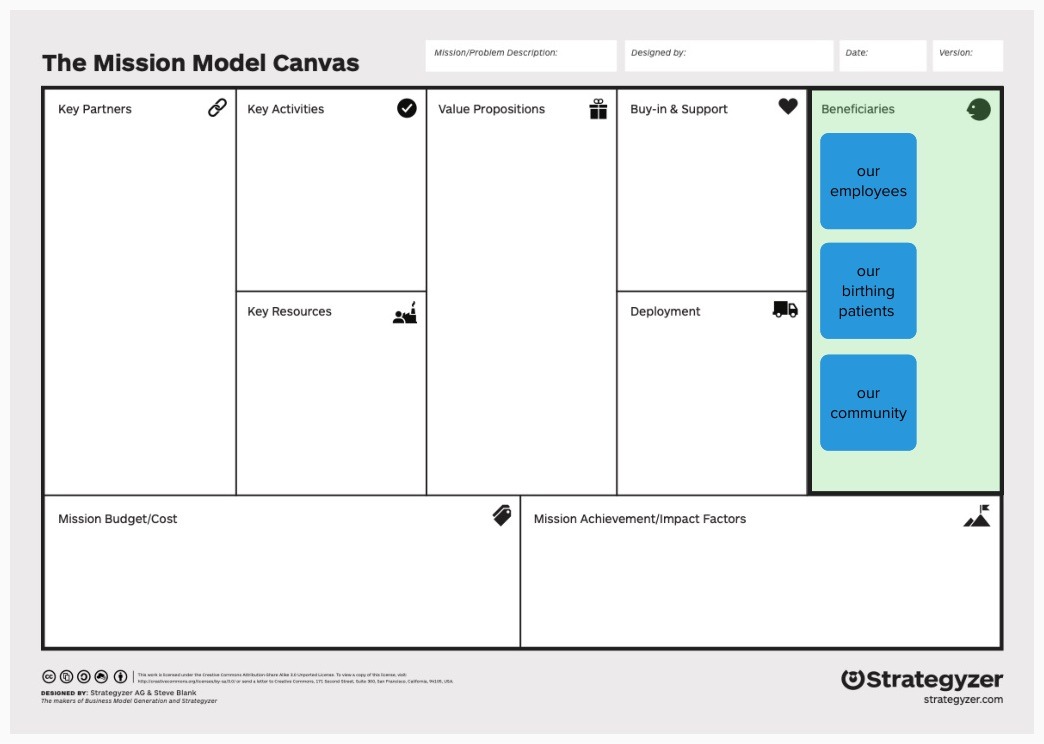
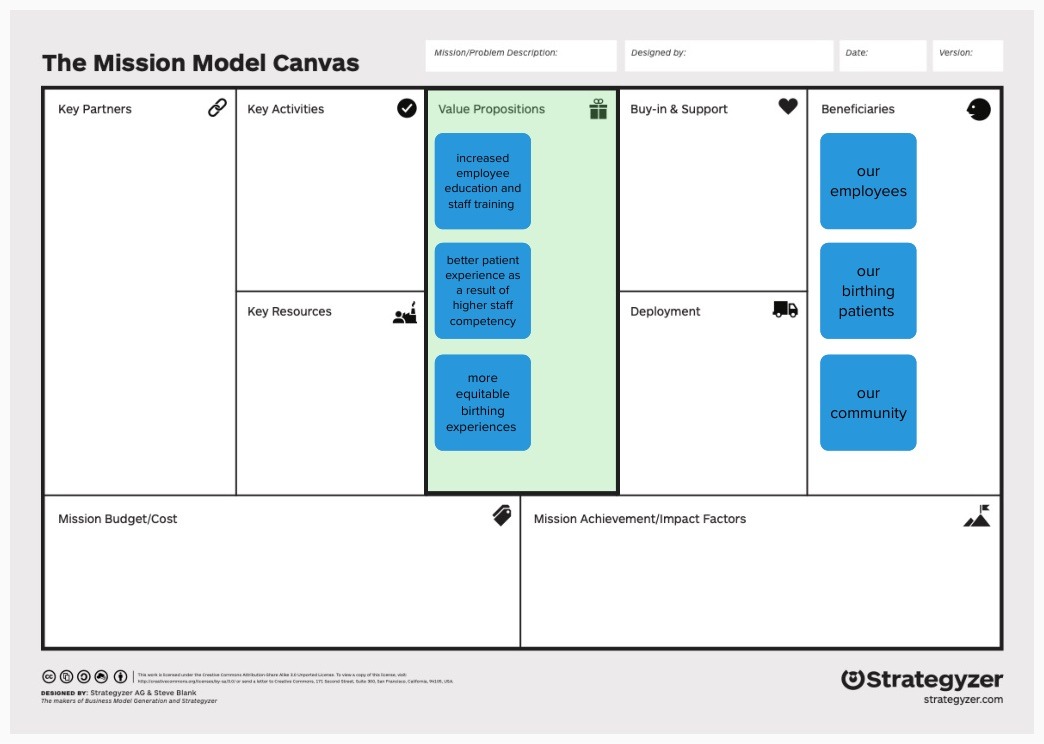
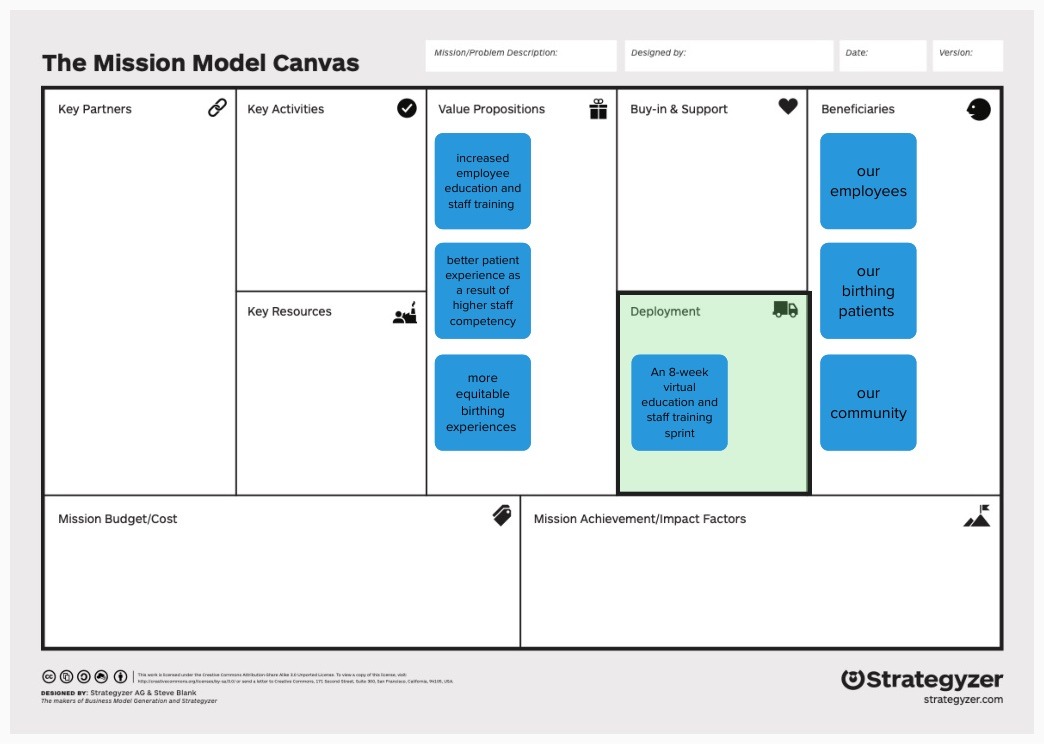
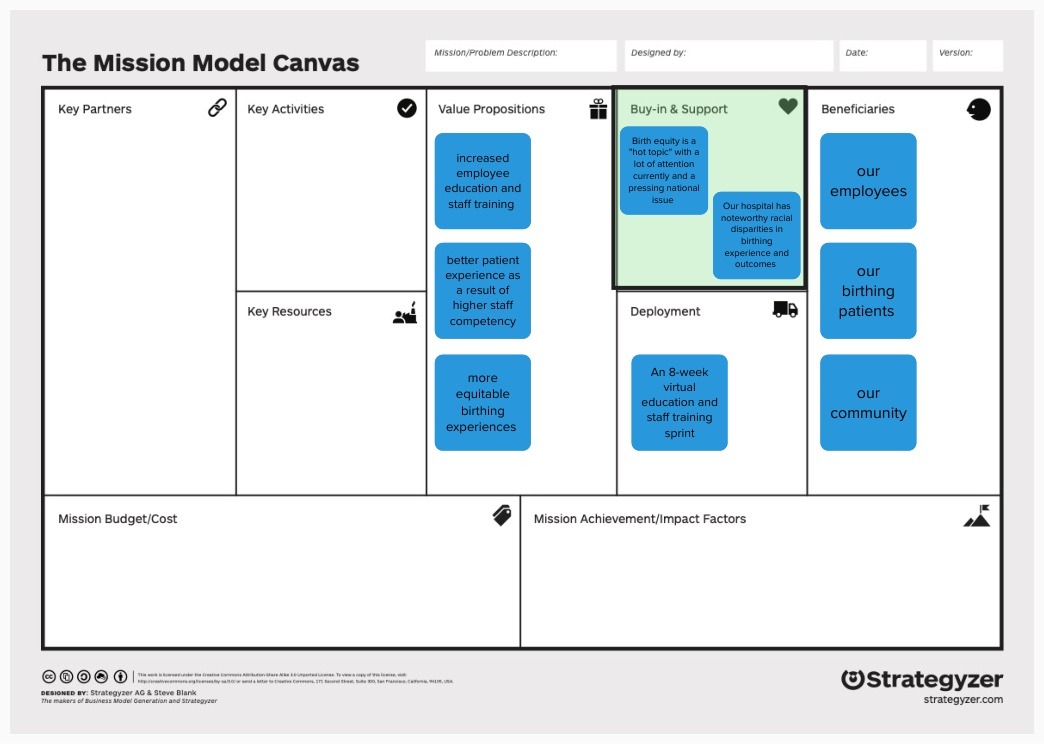
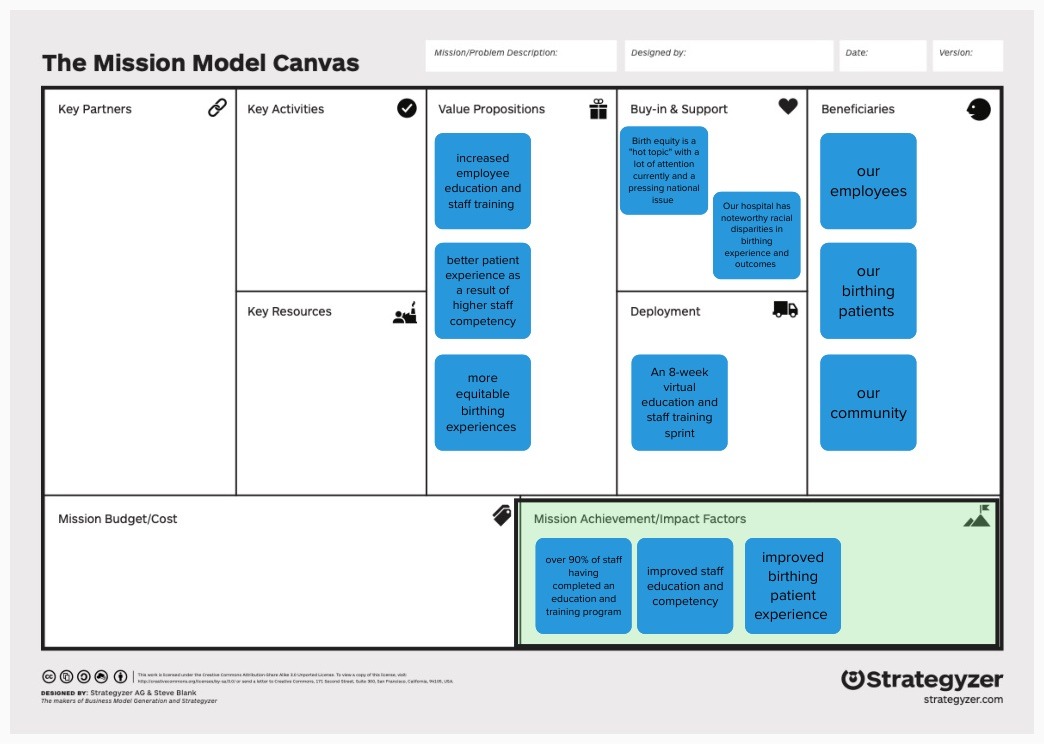
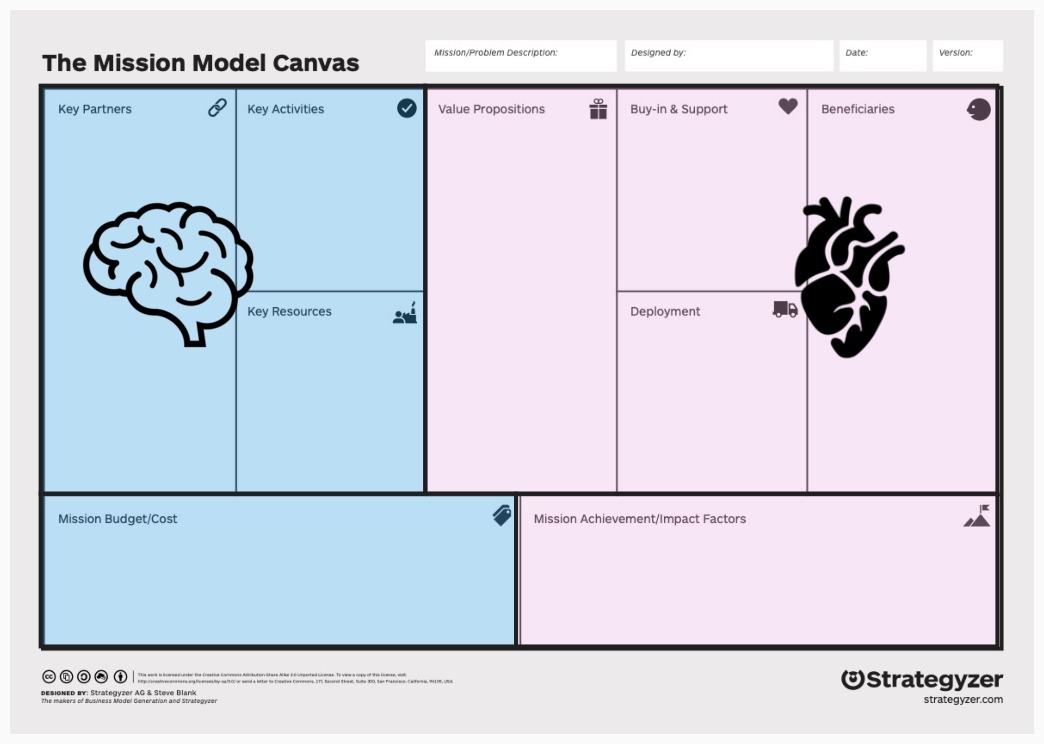
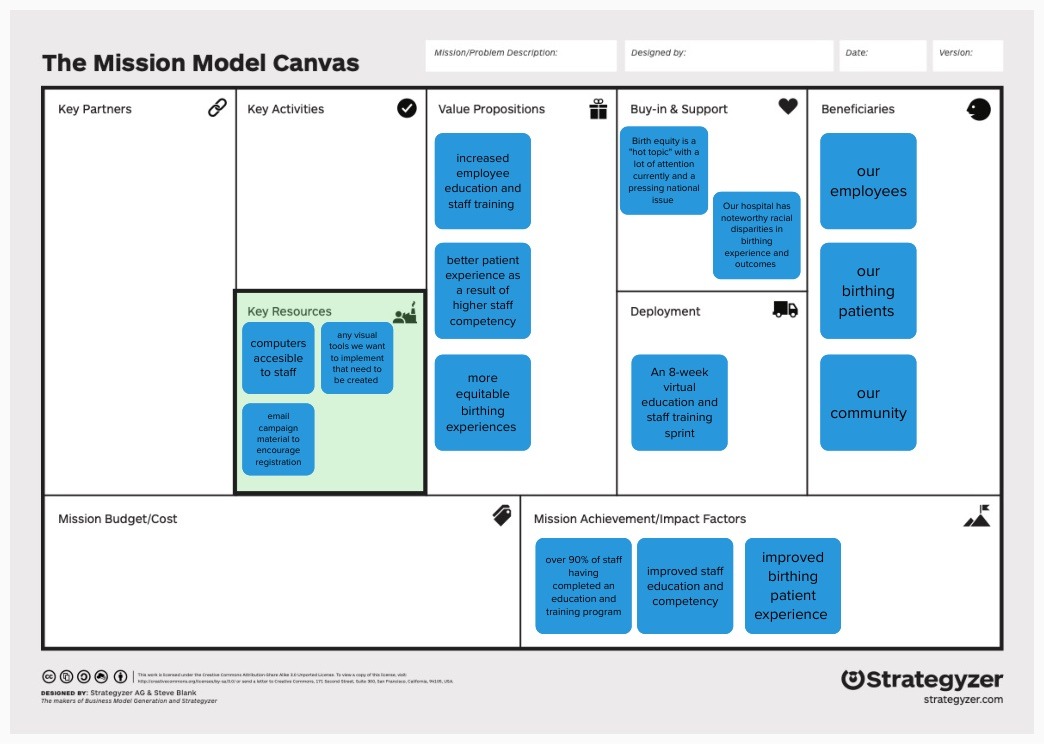
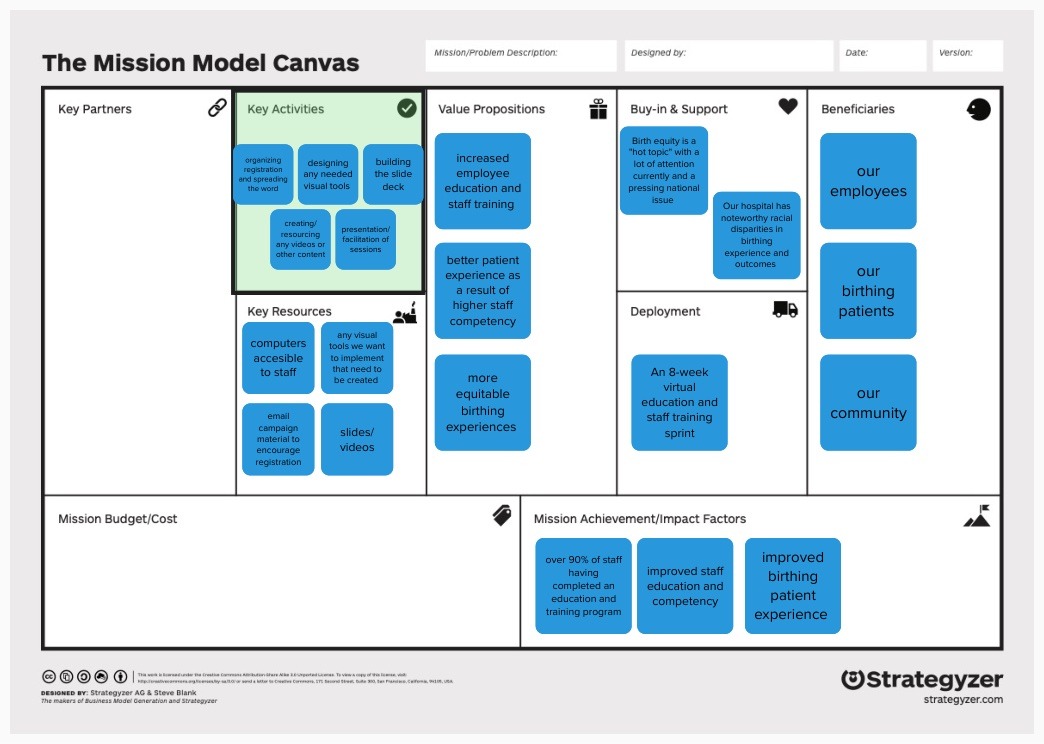
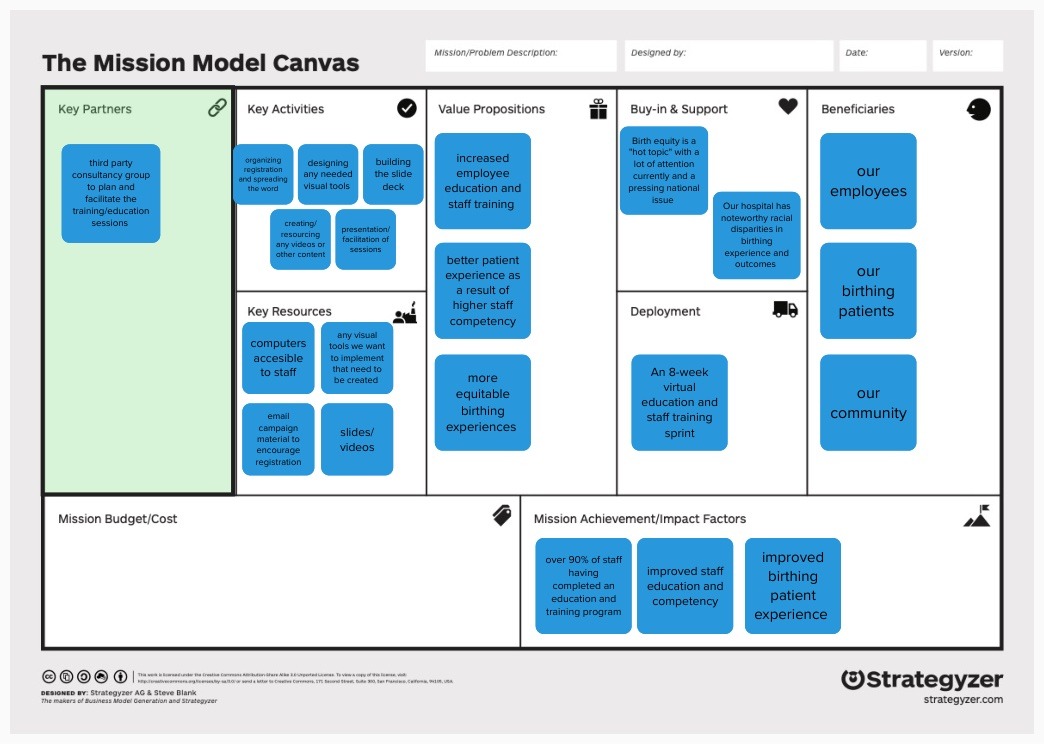
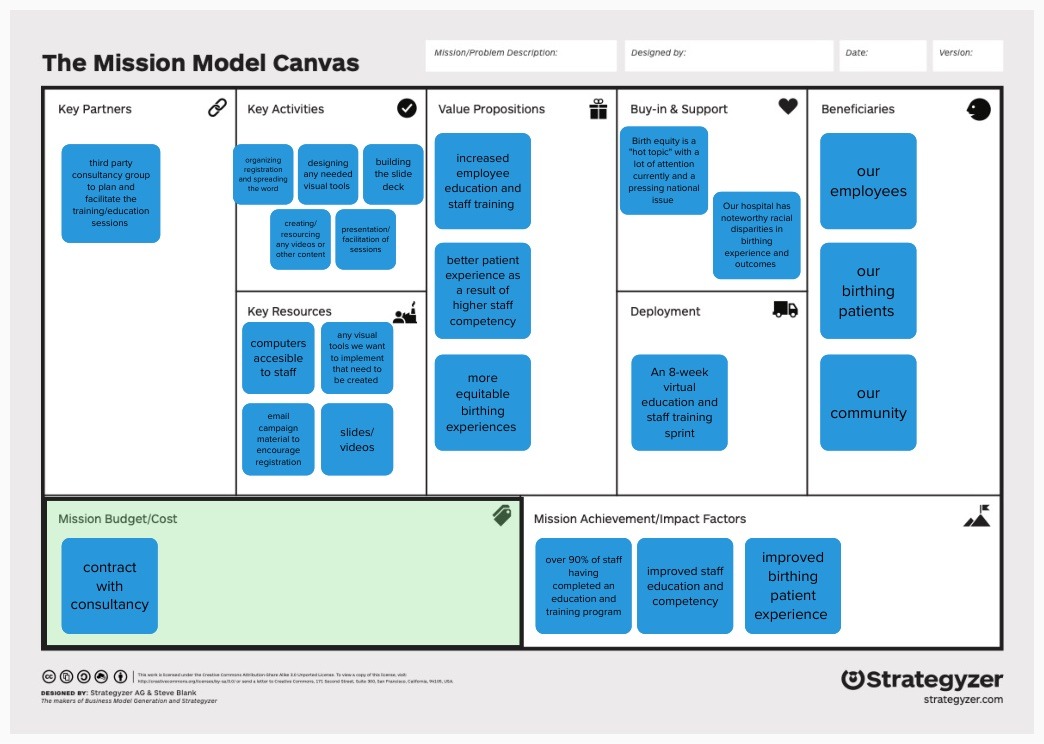
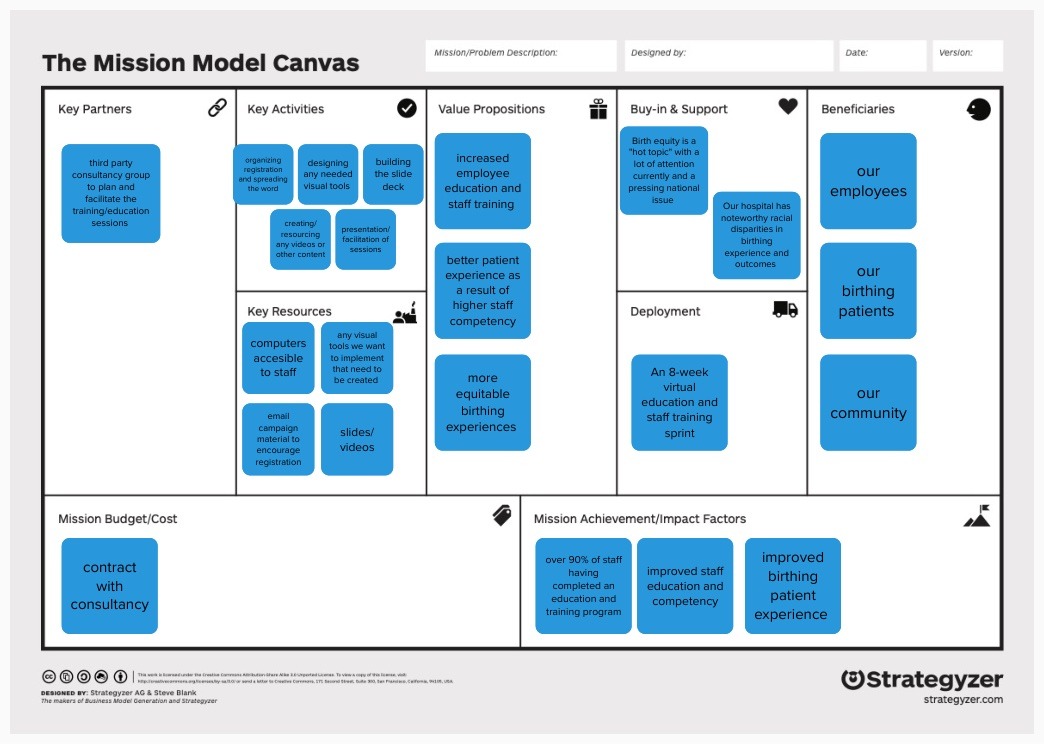
The Mission Model Canvas (MMC) is an adaptation of Alex Osterwalder’s Business Model Canvas, suited for equity work and change management in healthcare. It can be used as a current state analysis, future state analysis, or a storytelling tool. The MMC is broken into nine sections that are typically filled out in a particular order. The images provided work through  an example of what the MMC might look like for a hospital aiming to improve birth equity/maternal health education and training among staff.

Beneficiaries

Users start with the “Beneficiaries” section on the far right. Here, users define who they are trying to help by listing the different individuals or groups that benefit from the mission. Afterward, users are encouraged to reflect on the number of beneficiaries they generated. Are there too many, and would a smaller scope be more practical and effective? Are there two few, and could others benefit from this same work? If interested in building a more detailed mission model, users with multiple beneficiaries are welcome to color code their canvas by beneficiary or fill out a separate canvas for each one. 

Value Propositions

The second section users fill out is “Value Propositions” in the middle. This is where users define the value that they bring to their beneficiaries. Are users relieving an existing pain? Are they providing an advantage to beneficiaries? The “Value Propositions” section asks users to reflect on the what of their mission.

Deployment

The next section is “Deployment,” where users elaborate on how their value is brought to beneficiaries. Through what means will beneficiaries receive and access the value that is being provided to them. For example, your mission may be to increase employee education around maternal health. How do you provide your value proposition (education around maternal health) to beneficiaries (employees)? Maybe you create a website with remote training and modules? Or host an in-person workshop or learning collaborative focused on maternal health education? The “Deployment” section has users define the how of their mission.

Buy-in & Support

The fourth section users are directed to fill out is “Buy-in & Support.” Here, users brainstorm how they will get support from others, including leadership. Users elaborate on the why of their mission in this section – Why should others care? Why should others want to help?

Mission Achievement/Impact Factors

The fifth section is “Mission Achievement/Impact Factors,” where users list what the mission will accomplish. What are the overarching goals of this mission? What does this work accomplish? Users are encouraged to be specific here. For example, rather than saying “we will increase maternal health education among staff,” users could say “over 90% of our staff will complete maternal health education training.”

After the first five sections are complete, users have successfully filled out the right half of the canvas. This half is considered the “heart” of the mission – “what are you doing and why is it important?” On the other hand, the left half of the canvas is considered the “head” of the mission – “what do we need to realistically accomplish this mission?”

Key Resources

To kick off the left side of the canvas, users fill out “Key Resources,” where they define the items and materials needed to successfully complete their mission. For example, if you are hosting an in-person workshop, you may need printing, supplies, or catered lunch. This section also includes any internal people or teams that will need to be leveraged.


Key Activities

Next, users fill out “Key Activities,” where they define the tasks that need to be done to successfully complete the mission. Will they need to engineer something? Market something? Organize and garner registration?

Key Partners

Then, users fill out “Key Partners,” where they list any external partners that are essential to engage for the mission to succeed. For example, if users need to build an app or online hub, and they do not have access to an internal IT team, they would need to freelance software or web developers. Users should only include external partnerships that are indispensable to the mission in this section.

Mission Budget/Cost

Finally, once users have listed the resources, activities, and external partnerships necessary to complete their mission, they can estimate the “Mission Budget/Cost.” Here, users consider their different needs and reflect on how much it will realistically cost to complete their mission.

After completing the Mission Model Canvas, users have the outline for a comprehensive pitch of their mission. By going through the nine sections, users explain who they are benefiting, what they are doing to benefit them and how, why their mission is important, what they will need, and realistically how much it will cost. The MMC is an effective way to boil down a complex or convoluted mission into nine succinct points that can be pitched to leadership.

Strategy Number 2: The Seven Step Story

Another effective storytelling exercise is the “Seven Step Story,” which guides users through a seven step process that organizes their story in a succinct and effective way. Unlike the Mission Model Canvas, this strategy is used as a tool to retroactively tell the story of a mission, rather than a tool to craft a pitch. It is particularly useful if you are looking for a quick storytelling exercise or trying to outline a 1-pager, as it can be done in less than 10 minutes.The seven steps are as follows.

  1. Setting: who, where, what…users set the scene and define the protagonist and situation 
  2. Turning point: the trouble…users explain the challenge that arose 
  3. Overcoming struggle: the drama…users elaborate on the struggle faced by the protagonist 
  4. Resolution: the breakthrough…users explain how the challenge was eventually overcome 
  5. Implications: the lessons…users explain what was learned and what has changed since the resolution 
  6. Extra: the twist…users add in any extra twist or surprise that resulted from the resolution 
  7. Special: why does this story matter…users elaborate on why they care about the story, what it means to them, and what they hope others take away from it

Below is an example of what the Seven Step Story Process would look like applied to a fictional story about a QIO named Sally who took the initiative to organize an 8 week virtual staff education and training sprint for birth equity and maternal health.

Need help? Contact us:

contact-us-new
First
Last
optional

Invite Your Team

This platform is a collaborative space. Invite your team to help you out!

Equity Hub User Registration Invite
Do you want invites to be sent automatically?

Invite Team Members

Login

Register Interest:

collab-register-interest-new
Is your organization interested in participating in a future learning collaborative?
Session 1 community-select
Session 1 patients-select
Session 1 org-select
Session 1 training-select
Session 1 demo-select
spider 5 web canvas 5

5
5
5

5
5
5
5
spider 4 web canvas 4

5
5
5

5
5
5
5
spider 3 web canvas 3

10
10
9

2
10
10
10
spider 2 web canvas 2

10
10
10

5
8
9
9
matrix canvas

Rate each idea on a scale of 1-5(1 being low confidence and 5 being high confidence) for each criterion

No Entries Found
matrix canvas

Rate each idea on a scale of 1-5(1 being low confidence and 5 being high confidence) for each criterion

No Entries Found
matrix canvas

Rate each idea on a scale of 1-5(1 being low confidence and 5 being high confidence) for each criterion

No Entries Found
matrix canvas

Rate each idea on a scale of 1-5(1 being low confidence and 5 being high confidence) for each criterion

No Entries Found
matrix canvas

Rate each idea on a scale of 1-5(1 being low confidence and 5 being high confidence) for each criterion

No Entries Found
gameplan canvas
  • Instructions
  • Step 1
  • Step 2
  • Step 3
  • Step 4
  • Step 5
  • Step 6
  • Step 7
  • Save

gameplan canvas
  • Instructions
  • Step 1
  • Step 2
  • Step 3
  • Step 4
  • Step 5
  • Step 6
  • Step 7
  • Save
gameplan canvas
  • Instructions
  • Step 1
  • Step 2
  • Step 3
  • Step 4
  • Step 5
  • Step 6
  • Step 7
  • Save
gameplan canvas
  • Instructions
  • Step 1
  • Step 2
  • Step 3
  • Step 4
  • Step 5
  • Step 6
  • Step 7
  • Save
gameplan canvas
  • Instructions
  • Step 1
  • Step 2
  • Step 3
  • Step 4
  • Step 5
  • Step 6
  • Step 7
  • Save
gameplan canvas
  • Instructions
  • Step 1
  • Step 2
  • Step 3
  • Step 4
  • Step 5
  • Step 6
  • Step 7
  • Save

gameplan canvas
  • Instructions
  • Step 1
  • Step 2
  • Step 3
  • Step 4
  • Step 5
  • Step 6
  • Step 7
  • Save

spider 1 web canvas 1

10
10
10

5
9
9
5

Rate this hub

Please select a valid form