

The stress of working in health equity can cause interpersonal issues on our teams that impede our energy as change makers fighting to improve racial health equity in our organizations. Being mindful of team dynamics and using tools and strategies to maintain a healthy team culture can be a helpful way to avoid this.
Resource 1: Non-Violent Communication (NVC)
Poor communication can cause problems in care spaces, especially the racial health equity space. Non-violent communication, a concept devised by Marshall Rosenberg, allows everyone’s needs to be met through natural care and compassion. In this study (published March 2024), non-violent communication is shown to effectively improve communication on healthcare teams.
Here are the steps to using non-violent communication on your teams.
1. Distinguish and provide observations instead of evaluations
Are you able to identify what you see or hear about a situation? Or, is it hidden behind an evaluation or judgment? If we were to say, “She always…” or “They never…”, these qualifiers may be perceived as a criticism and elicit defensiveness. Instead, begin by stating an observation.
Examples:
- “When I hear…”
- “When I see…”
- “I’ve noticed how…”
“What I remember is how you…”
2. Relate the observation to a feeling
Pay attention to what feelings arise in relation to the observation and then name them. Often we use words that describe thoughts instead of conveying feelings. For example, “rejected” can be an interpretation of how others evaluate us rather than the feeling of “sadness” or “confusion” which their actions evoke. Similarly, we might say “inadequate” when we mean “nervous” or “uncomfortable”. When we use phrases such as “I feel like…”, “I feel that…”, “I feel they…” and “I feel as if…”, we are entering the evaluation space and at the risk of blaming ourselves or others. To help with specificity around feelings, here is a list of feelings .
Examples:
- “…I feel pleased…”
- “…I feel hurt…”
- “…I feel frustrated…”
“…I feel worn out…”
3. Identify the need, value, or expectation
Struggling to express what we need, value, or expect in a situation is common when we are under stress. When an unmet need is expressed through a judgment or evaluation of the person we are engaging with, the listener is likely to react defensively. When we create direct links between our feelings and needs, compassion arrives and connection. To help with specificity of needs, here is a needs inventory list.
Examples:
- “…because I need more choice”
- “…because I value honesty“
- “Clear communication is important to me”
“This doesn’t meet my need for trust ”
4. Present your requests
The last step is to explain what specific action can be taken to meet your needs. The language should be clear, concrete, and positive; what you want rather than what you don’t want. If we simply say that we want to be treated fairly or included more in a discussion, there is nothing specific for the listener to act upon. A request will be seen as a demand if there is a perception of blame or punishment for not saying “Yes”. We can reduce perceived demands by asking what the person is willing to do.
Examples:
- “Would you be willing to…?”
- “Are you able to…?”
- “Can I ask you to…?”
“I’d like you to…”
Examples of NVC for teams
“I’ve noticed how you ask for help with personal issues during our monthly check-ins that often take up time for work issues. I feel worried because it’s important to me that we focus our conversations on work topics. I’d like you to self-monitor how much time we are taking to discuss personal issues; would you be willing to do that?”
“I’m disappointed when I don’t get a response to my emails. I need regular communication about what’s happening on teams I manage, as I want to find out what is affecting deadlines. Would you be free to meet with me this week, so that I can learn more about what you are seeing on your team and receive answers to the questions in my emails?”
Receiving Messages with Empathy using NVC
Honesty in expressing our own feelings and needs is important and only half of the equation. Additionally, we need to receive messages from others with empathy.
1. Turn it around
The four stages of NVC outlined above, with a slight change in language, also apply here:
- Observations: “When you see/hear…”
- Feelings: “…you feel…”
- Needs: “…because you need/value…”
- Requests: “Would you like…?”; “I am willing to…”; “Do you want me to…?”
Example:
“During our team meeting, are you feeling annoyed when you say, ‘No-one listens to me’? You need to know that you are accepted and heard. How about I pause the discussion right now and you can spend the next two minutes describing your ideas while everyone else listens?”
2. Be in the present while listening
This might be the toughest part of NVC. It involves listening intently and focusing explicitly on the feelings and needs being expressed to you. Being an effective receiver means withholding judgements and evaluations of the person, regardless of our previous interactions or what others have said. If we start to focus on these thoughts, these can quickly become self-fulfilling prophecies and create a pathway to conflict.
3. Avoiding Isolating Language
Isolating language describes responses which can be perceived as judgemental, critical, and isolating. Consider when you have said or heard something like the examples below and what feelings these words might have evoked for your listener. Think about when you have received these phrases. How did you feel?
- Blaming: “I think you were in the wrong”
- Shaming: “I’m so disappointed in you”
- Directing: “If I were you, I would…”
- Competing: “You think that’s bad? Wait until you hear about….”
- Sympathizing: “I’m sorry you feel that way”
- Consoling: “There was nothing you could have done”
- Dismissing: “You just need to put it out of your head”
- Correcting: “That’s not how it happened”
4. Take time to reflect back what you heard
What we hear may not be what the person meant. It’s important to clarify the feelings and needs being expressed. We might paraphrase what the person is saying and ask, “Are you saying that you feel nervous about…” or “I wonder if you’re feeling angry about…?” The speaker can then confirm or correct our understanding.
In conclusion, non-Violent Communication takes practice. However, when we put effort into using non-Violent Communication, we foster healthy team dynamics and avoid communication-based conflict that impedes our equity work.
References: Non-Violent Communication by Marshall Rosenberg and the blog Ed Psych Insight by Dr. Chris Moore.
Resource 2: The Culture Map
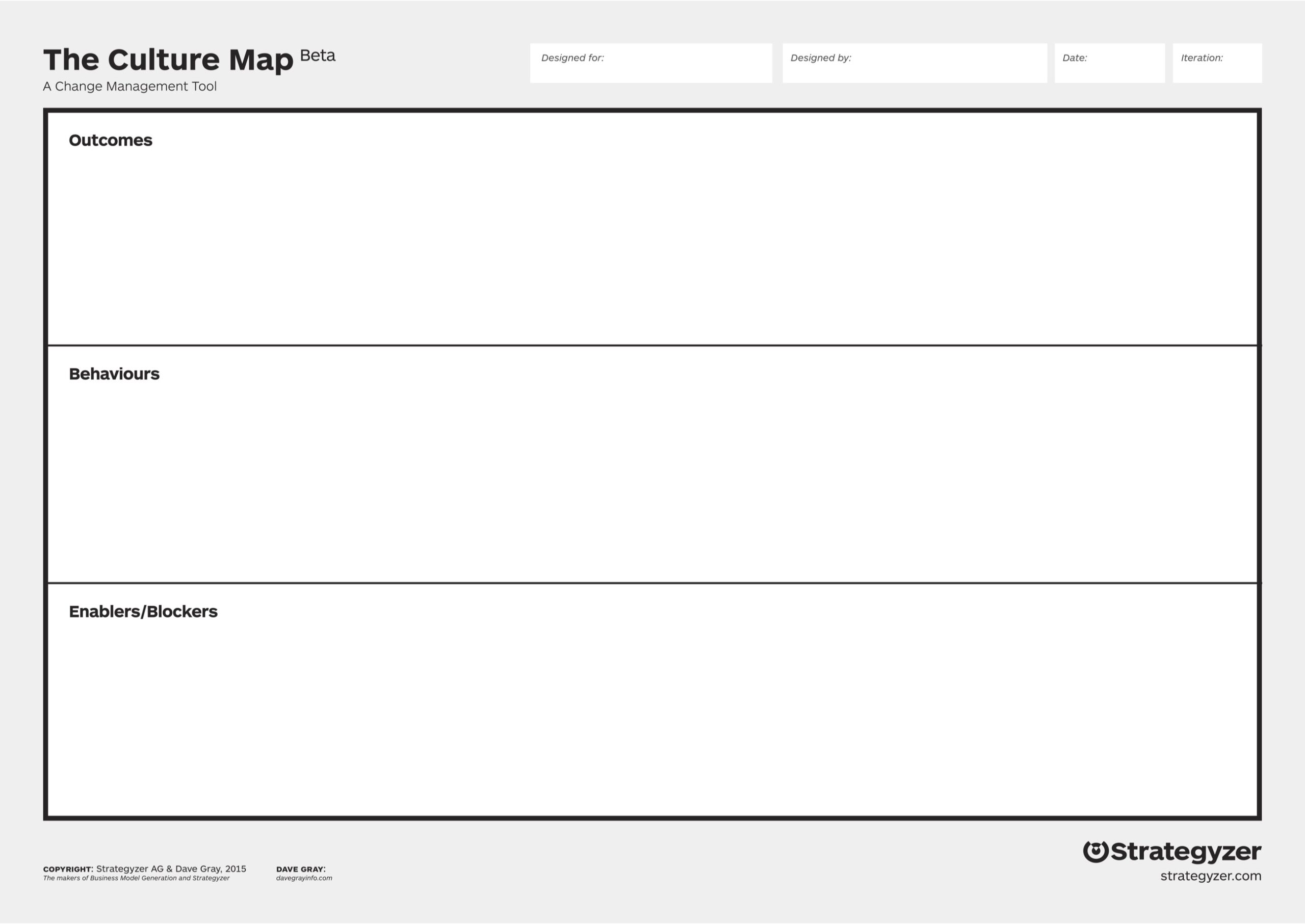
Dave Gray, author of The Connected Company, developed “The Culture Map” as a tool to design better performing companies. Alex Osterwalder and the teams at Strategyzer collaborated with Dave to make it a practical and simple visual tool. You can use The Culture Map to map out an existing or desired state, or to communicate your culture internally.
How to use The Culture Map:
- Start by mapping behaviors: In this box, map out how your team/company acts or conducts itself. What do you do or say? How do you interact? What patterns do you notice?
- Next, map your outcomes: What are the positive or negative consequences of the behaviors you’ve identified?
- Finish by mapping your enablers and blockers: Take time mapping out all of the things that lead to positive or negative behaviors inside your team/company. What policies, actions, or rules are influencing employees behaviors, and ultimately influencing your company’s outcomes?
Once completed, decide what you will do with this information. What can you change? What can’t you change? Make choices as a team what change you will commit to.
Resource: The Culture Map by Alex Osterwalder